
Master French from A1 to B1 with live classes, speaking practice, grammar, vocabulary and DELF exam-focused preparation.
Learn French from A1 to B1 with a structured CEFR-aligned learning pathway, live interactive classes, speaking practice, grammar training, vocabulary development, and DELF-focused preparation.

Bonjour! 🇫🇷
Have you always wanted to learn French but didn't know where to start?
Whether you are a complete beginner, a student preparing for higher education, a professional looking for international opportunities, a traveller, or someone preparing for a French-language certification, the French A1–B1 learning pathway gives you a clear route from basic French to independent communication.
At Impearly, our French program is designed to help you progress systematically through A1, A2 and B1, combining grammar, vocabulary, pronunciation, listening, reading, writing and, most importantly, speaking.
The CEFR describes A1 as a very basic level focused on familiar expressions and concrete needs, while B1 represents a significantly more independent ability to understand and communicate about familiar everyday and work-related topics.
🚀 Ready to Start Learning French?
Don't spend months jumping between random YouTube videos, apps and textbooks.
Follow a structured French learning pathway with:
✅ Live interactive French classes
✅ A1–B1 structured curriculum
✅ French-speaking practice
✅ Grammar masterclasses
✅ Vocabulary development
✅ Listening and reading practice
✅ Writing correction
✅ Pronunciation training
✅ DELF-focused preparation
✅ Mock tests and practice activities
✅ Digital learning materials
✅ Personalised academic support
👉 Start Your French Journey with Impearly
🇫🇷 What Are French A1, A2 and B1?
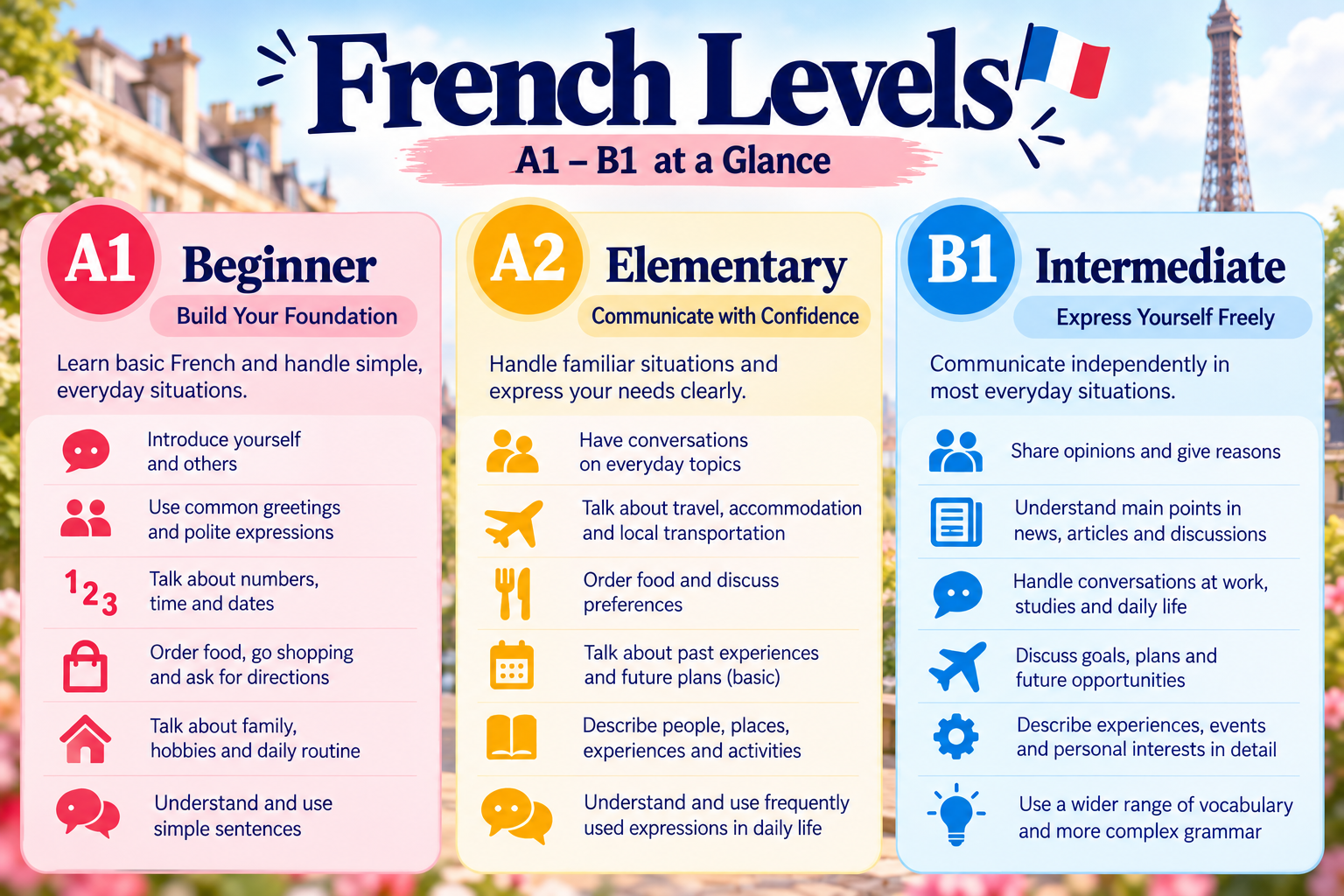
The Common European Framework of Reference for Languages (CEFR) provides a framework for describing language proficiency.
For French learners, the progression from A1 to B1 represents an important transformation:
A1 → Basic French
A2 → Everyday French
B1 → Independent French
France Éducation international's level descriptors similarly describe A1 as understanding very short, simple texts and familiar information, A2 as handling simple everyday needs, and B1 as understanding straightforward information and communicating about familiar topics such as work, travel, family and current events.
🟢 French A1 – Beginner Level
Build Your French Foundation
French A1 is where your journey begins.
If you have never studied French before, A1 gives you the essential vocabulary, grammar and pronunciation needed to begin communicating.
You don't need to know French before joining a beginner A1 course.
What will you learn at French A1?
You will learn how to:
- Introduce yourself
- Say your name and nationality
- Talk about your family
- Describe your daily routine
- Talk about hobbies
- Ask basic questions
- Answer simple questions
- Talk about likes and dislikes
- Order food and drinks
- Shop in French
- Tell the time
- Talk about dates
- Ask for directions
- Make simple appointments
- Describe people and places
- Handle basic travel situations
A1 French Vocabulary
You will gradually develop vocabulary around:
👋 Greetings
Bonjour, Salut, Bonsoir, Au revoir
👨👩👧 Family
La famille, les parents, la mère, le père, le frère, la sœur
🏠 Home
La maison, l'appartement, la chambre, la cuisine
🍎 Food
Le pain, le fromage, les fruits, les légumes, le café
🕐 Time
Aujourd'hui, demain, hier, matin, soir, semaine
💼 Work
Le travail, le bureau, le collègue, le professeur
🎨 Hobbies
La musique, le sport, les voyages, le cinéma
A1 French Grammar
Your A1 foundation includes:
- French alphabet
- Pronunciation
- Gender
- Singular and plural
- Definite and indefinite articles
- Subject pronouns
- Être
- Avoir
- Regular -ER verbs
- Common irregular verbs
- Negation
- Question formation
- Possessive adjectives
- Demonstrative adjectives
- Basic prepositions
- Adjectives
- Numbers
- Dates
- Time expressions
- Basic sentence structures
A1 Speaking Example
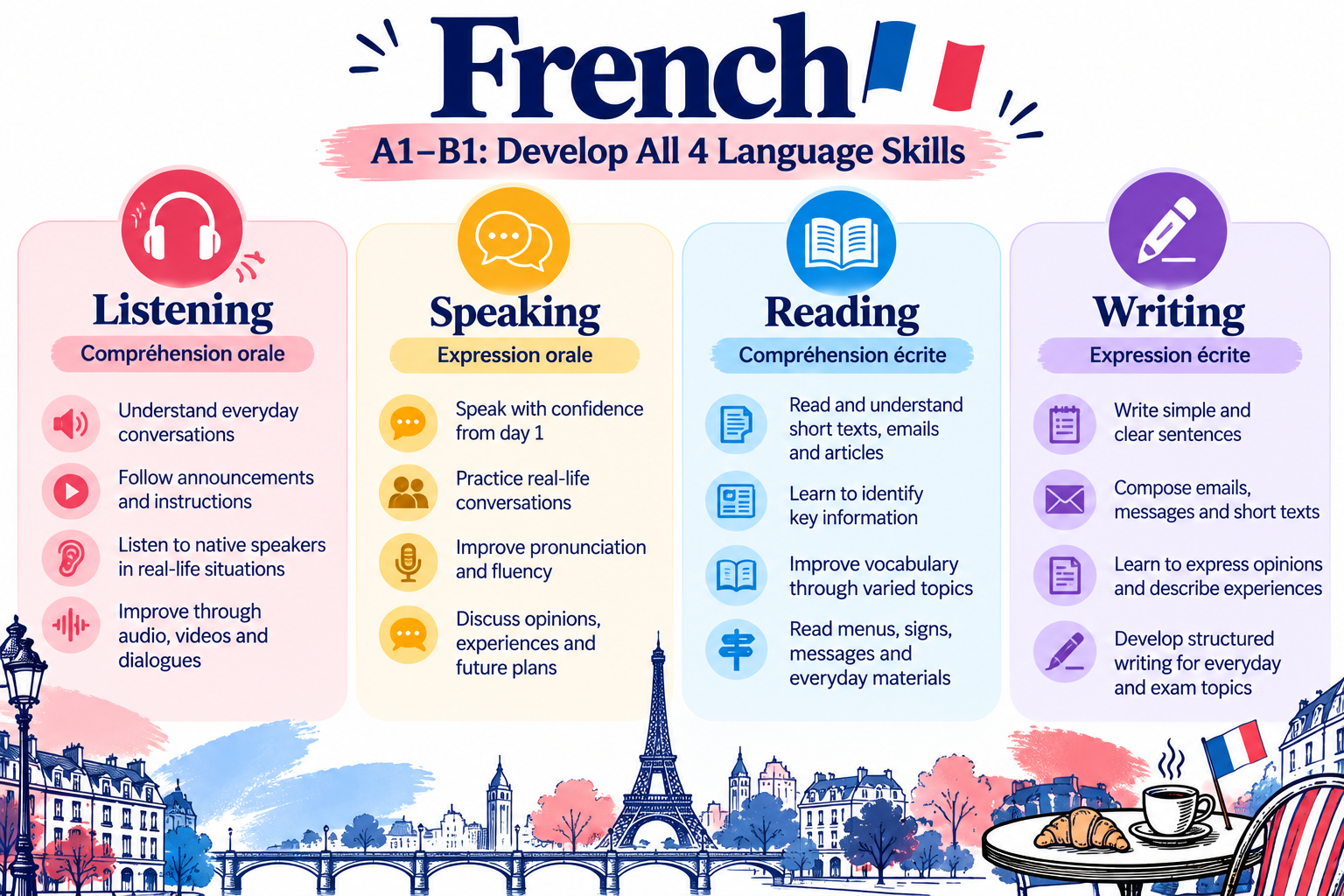
You will gradually move from:
Bonjour.
to:
Bonjour, je m'appelle Anna. Je suis indienne, et j'habite à Chennai. Je travaille dans une entreprise internationale. J'aime voyager et écouter de la musique.
The objective is not simply to memorise sentences.
The objective is to learn how to create your own sentences.
🟡 French A2 – Elementary Level
Move From Basic French to Everyday Communication
Once you have built your A1 foundation, A2 takes your French to the next stage.
You begin communicating more comfortably about familiar situations, experiences and plans.
At A2, learners can handle simple communication around immediate priorities and routine situations.
What will you learn at French A2?
You will learn to:
- Talk about your past
- Talk about future plans
- Describe experiences
- Discuss your daily routine
- Talk about your education
- Talk about your profession
- Describe your city
- Make reservations
- Ask for information
- Give directions
- Explain simple problems
- Make requests
- Give basic opinions
- Write emails
- Write messages
- Have longer conversations
Important A2 grammar areas include:
- Present tense
- Passé composé
- Imparfait introduction
- Future tense
- Near future
- Reflexive verbs
- Object pronouns
- Comparatives
- Superlatives
- Imperative
- Adverbs
- Prepositions
- Conjunctions
- Expanded question structures
- Sentence connectors
A2 Speaking Practice
You will practise real-life conversations such as:
At a restaurant
At a hotel
At an airport
At a railway station
At a doctor's appointment
While shopping
Making plans with friends
Talking about your weekend
Discussing your future plans
Instead of simply knowing French grammar, you begin using French spontaneously in familiar situations.
🔵 French B1 – Intermediate Level
Become a More Independent French Speaker
B1 is a major milestone.
At this level, you move beyond simple conversations and begin expressing your thoughts, experiences, opinions and plans with greater independence.
France Éducation international describes B1 learners as being able to understand straightforward factual information on everyday or job-related topics and communicate about familiar subjects including family, hobbies, work, travel and current events.
What will you learn at French B1?
You will learn to:
- Tell stories
- Describe experiences
- Explain problems
- Express opinions
- Give reasons
- Agree and disagree
- Give advice
- Compare ideas
- Discuss current topics
- Talk about education
- Talk about work
- Discuss travel
- Explain future plans
- Participate in conversations
- Write structured texts
- Understand longer conversations
B1 French Grammar
Your B1 grammar development can include:
- Present tense
- Passé composé
- Imparfait
- Plus-que-parfait
- Future simple
- Conditional
- Subjunctive introduction
- Relative pronouns
- Object pronouns
- Y and en
- Si clauses
- Reported speech
- Cause and consequence
- Purpose
- Condition
- Contrast
- Opinion structures
- Complex sentence formation
- Linking words
B1 Speaking Example
Instead of saying:
J'aime voyager.
You can develop the idea:
J'aime voyager parce que cela me permet de découvrir de nouvelles cultures. L'année dernière, j'ai voyagé en France et j'ai particulièrement apprécié Paris. À l'avenir, j'aimerais visiter d'autres régions françaises parce que chaque région possède sa propre culture et sa propre gastronomie.
That is the type of progression learners work toward as they develop greater vocabulary, grammatical range and communication skills.
The journey:
A1 → “I can introduce myself.”
A2 → “I can manage everyday conversations.”
B1 → “I can explain my ideas and participate in conversations.”
🎯 French DELF Preparation
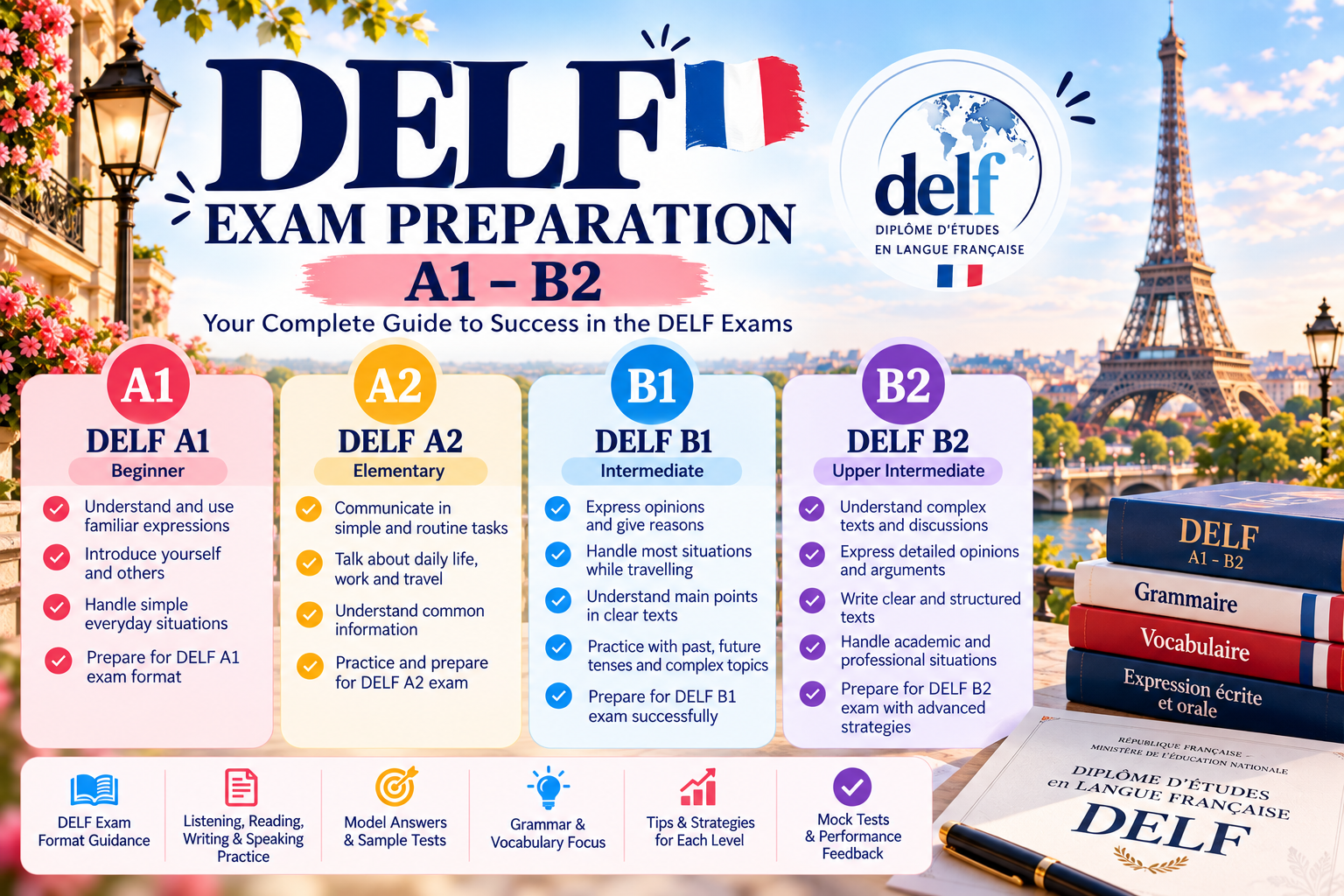
Prepare Smarter. Not Just Harder.
If your goal is French certification, structured exam preparation can make a major difference.
The DELF is an official French-language diploma system issued under the authority of the French Ministry responsible for national education. DELF qualifications correspond to CEFR levels.
At Impearly, our French courses can incorporate DELF-focused preparation alongside language development.
DELF Preparation Areas
🎧 Listening
Develop the ability to identify:
- Main ideas
- Key information
- Names
- Dates
- Places
- Numbers
- Opinions
- Specific details
📖 Reading
Learn strategies for:
- Understanding short texts
- Identifying keywords
- Finding specific information
- Understanding context
- Recognising the purpose of a text
✍️ Writing
Practise:
- Messages
- Emails
- Descriptions
- Personal experiences
- Opinions
- Structured responses
🗣️ Speaking
Develop your ability to:
- Introduce yourself
- Answer questions
- Describe situations
- Express opinions
- Explain ideas
- Interact with another speaker
France Éducation international publishes official DELF information and materials, including specifications and evaluation resources for A1, A2 and B1.
🧠 Why Speaking Practice Matters When Learning French
Many learners can complete grammar exercises but struggle when somebody actually speaks French to them.
Why?
Because studying a language and using a language are different skills.
That is why speaking practice should be integrated throughout your French learning journey.
At Impearly, learners can practise:
🗣️ Everyday Conversations
💼 Professional Conversations
✈️ Travel Conversations
🎓 Academic Conversations
💬 Opinion-Based Discussions
🎭 Role Plays
🎤 Presentation Practice
The goal is to help you become more comfortable thinking and responding in French.
📚 Complete French A1–B1 Curriculum
French A1
Module 1 — Introduction to French
- Alphabet
- Sounds
- Pronunciation
- Greetings
- Introductions
Module 2 — Personal Information
- Name
- Age
- Nationality
- Profession
- Address
Module 3 — Family & People
- Family vocabulary
- Descriptions
- Possessive adjectives
Module 4 — Daily Life
- Routine
- Time
- Days
- Months
- Activities
Module 5 — Food & Shopping
- Food vocabulary
- Ordering
- Prices
- Quantities
Module 6 — Places & Directions
- City vocabulary
- Transport
- Directions
Module 7 — Grammar Foundation
- Articles
- Pronouns
- Verbs
- Negation
- Questions
- Adjectives
Module 8 — A1 Speaking & Exam Practice
- Conversations
- Role plays
- Listening
- Reading
- Writing
- Mock practice
French A2 Curriculum
Module 1 — Everyday Communication
Module 2 — Past Experiences
Module 3 — Future Plans
Module 4 — Travel
Module 5 — Work & Education
Module 6 — Health & Lifestyle
Module 7 — Shopping & Services
Module 8 — Opinions & Preferences
Module 9 — A2 Grammar
Module 10 — Speaking & Writing
Module 11 — Listening & Reading
Module 12 — DELF A2 Practice
French B1 Curriculum
Module 1 — Personal Experiences
Module 2 — Work & Professional Life
Module 3 — Education
Module 4 — Travel & Culture
Module 5 — Media & Technology
Module 6 — Society & Lifestyle
Module 7 — Opinions & Discussions
Module 8 — Advanced Everyday Grammar
Module 9 — Writing Development
Module 10 — Speaking Development
Module 11 — Listening & Reading
Module 12 — DELF B1 Preparation
⭐ Why Choose Impearly to Learn French?
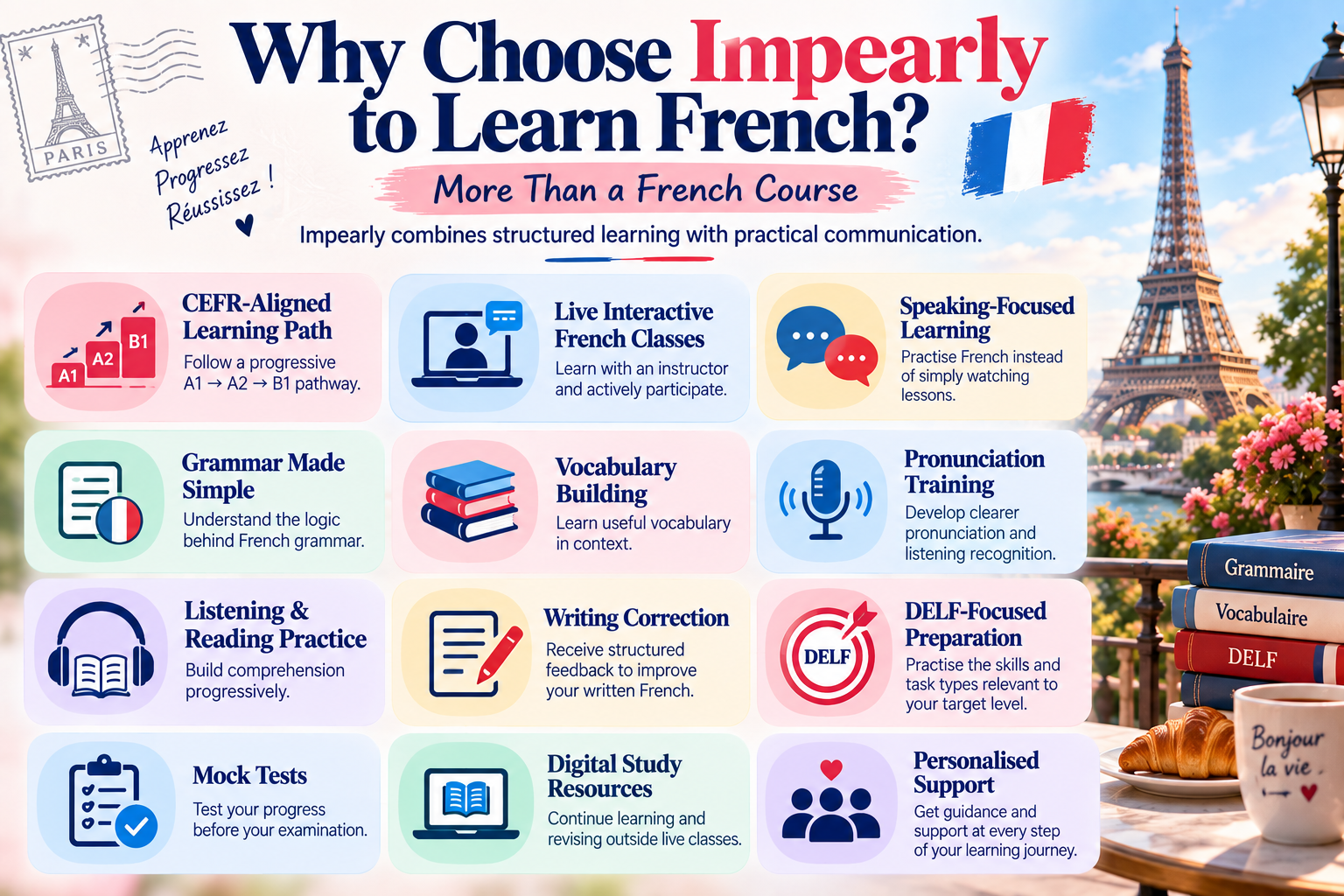
More Than a French Course
Impearly combines structured learning with practical communication.
✅ CEFR-Aligned Learning Path
Follow a progressive A1 → A2 → B1 pathway.
✅ Live Interactive French Classes
Learn with an instructor and actively participate.
✅ Speaking-Focused Learning
Practise French instead of simply watching lessons.
✅ Grammar Made Simple
Understand the logic behind French grammar.
✅ Vocabulary Building
Learn useful vocabulary in context.
✅ Pronunciation Training
Develop clearer pronunciation and listening recognition.
✅ Listening & Reading Practice
Build comprehension progressively.
✅ Writing Correction
Receive structured feedback to improve your written French.
✅ DELF-Focused Preparation
Practise the skills and task types relevant to your target level.
✅ Mock Tests
Test your progress before your examination.
✅ Digital Study Resources
Continue learning and revising outside live classes.
✅ Personalised Support
Identify weaknesses and work toward your language goals.
👩🎓 Who Should Learn French?

Our French A1–B1 course is ideal for:
Students
Build French skills for academic and personal development.
Working Professionals
Develop an additional language for international careers.
Job Seekers
Strengthen your communication profile for international opportunities.
Travellers
Communicate more confidently during travel.
France Aspirants
Build a strong French foundation before studying or working in France.
DELF Candidates
Prepare systematically for your target level.
Business Professionals
Develop communication skills for Francophone markets.
Language Enthusiasts
Learn one of the world's major international languages.
⏳ How Long Does It Take to Learn French A1–B1?
There is no universal number of days required to reach a language level.
Your progress depends on:
- Previous language-learning experience
- Number of classes per week
- Self-study time
- Speaking practice
- Vocabulary revision
- Exposure to French
- Individual learning speed
- Consistency
The most important factor?
Consistency.
Thirty minutes of focused French practice every day can be more valuable than studying for several hours only once a week.
🔥 The Impearly French Learning Formula
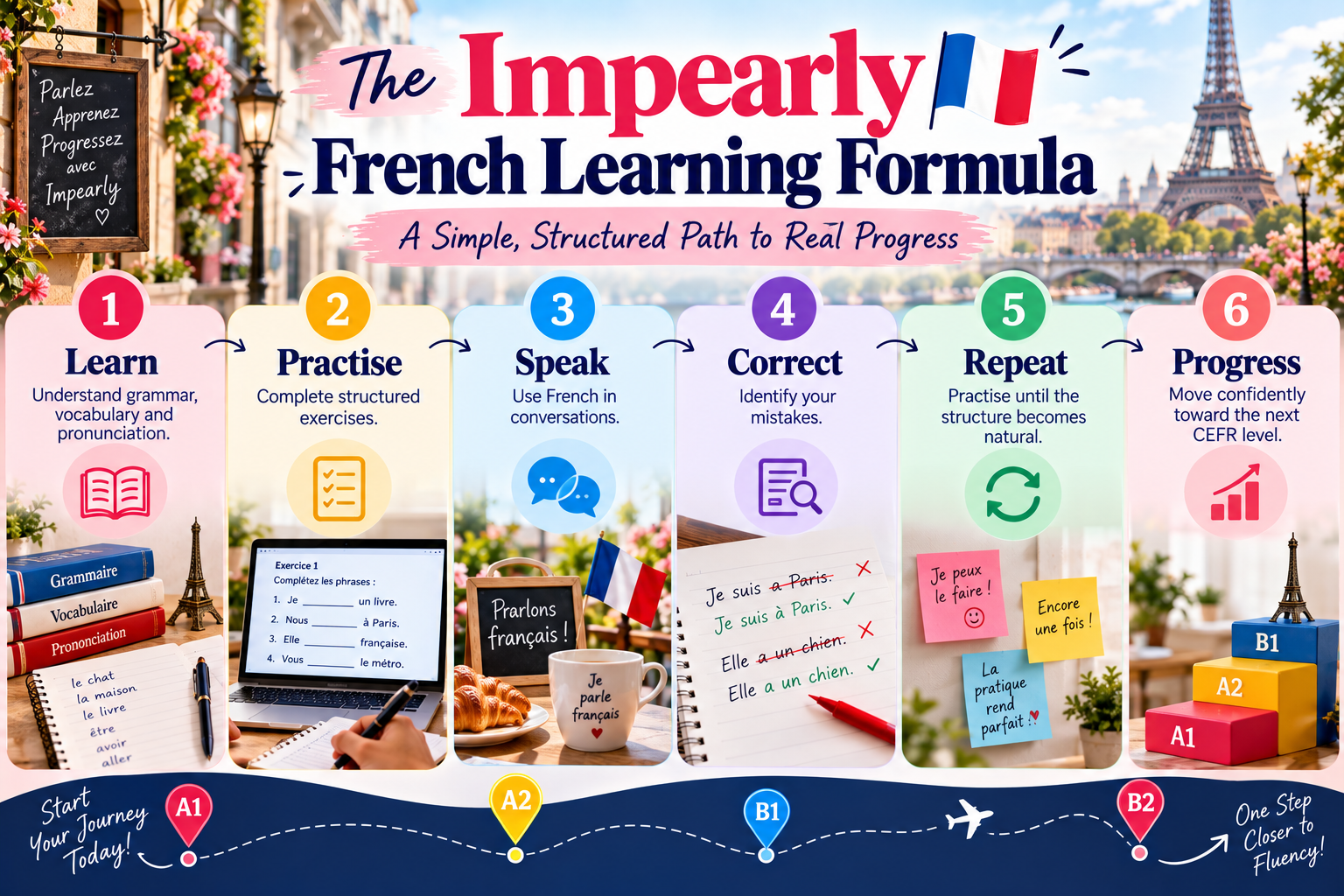
Learn
Understand grammar, vocabulary and pronunciation.
↓
Practise
Complete structured exercises.
↓
Speak
Use French in conversations.
↓
Correct
Identify your mistakes.
↓
Repeat
Practise until the structure becomes natural.
↓
Progress
Move confidently toward the next CEFR level.
❓ Frequently Asked Questions About French A1–B1
Can I learn French from A1 if I am a complete beginner?
Yes. A1 is the beginner stage, so you can start without previous French knowledge.
Can I join A2 without taking A1?
Yes, if you already have sufficient A1-level knowledge. A placement assessment can help determine the appropriate starting level.
Can I join B1 directly?
If you already have strong A2-level French, you may be able to begin at B1. A level assessment is recommended.
Is French difficult to learn?
French has some challenging areas, particularly pronunciation, verb conjugation, gender and listening comprehension. However, a structured learning pathway can make the progression much easier.
How can I improve my French speaking?
Speak regularly. Use role plays, conversations, question-answer activities, presentations and real-life scenarios.
Is French A1 enough to speak French fluently?
No. A1 is an introductory level. Fluency develops progressively as your vocabulary, grammar, listening comprehension and speaking ability increase.
Is B1 a good French level?
Yes. B1 represents an important intermediate milestone and enables learners to communicate about many familiar everyday and work-related topics.
Does Impearly provide DELF exams?
Impearly's course can provide DELF-focused preparation. Official DELF examinations and diplomas are administered through the authorized DELF-DALF examination network. Check the official examination centre for registration and examination arrangements.
💡 10 Tips to Learn French Faster
1. Learn French Every Day
Consistency is more important than occasional intensive study.
2. Speak From Day One
Don't wait until you "know enough French."
3. Learn Vocabulary in Context
Learn:
prendre une décision
rather than only:
prendre = to take
4. Listen to French Regularly
Train your ears to recognise natural French pronunciation.
5. Read Short French Texts
Start simple and progressively increase difficulty.
6. Write Every Week
Write messages, diary entries, descriptions and opinions.
7. Revise Grammar
Grammar gives you the structure needed to build accurate sentences.
8. Record Yourself Speaking
Listen to your pronunciation and identify areas for improvement.
9. Use French Outside the Classroom
Change your phone settings, watch French content and practise everyday phrases.
10. Have a Clear Goal
Instead of saying:
"I want to learn French."
Set a measurable target:
"I want to reach A2 in six months."
or
"I want to prepare for DELF B1."
🌟 From Your First Bonjour to Confident French
Learning French doesn't happen overnight.
But with the right structure, consistent practice and regular speaking, you can make measurable progress.
Your journey can look like this:
🇫🇷 A1
Learn the basics.
↓
🇫🇷 A2
Communicate in everyday situations.
↓
🇫🇷 B1
Express yourself more independently.
↓
🎯 DELF
Demonstrate your French proficiency through certification.
🚀 Ready to Learn French?
You don't need to know where to begin.
You don't need to speak perfect French.
You simply need to start.
At Impearly, we help learners build their French step by step through a structured A1–B1 learning pathway.
🇫🇷 Start with A1.
🇫🇷 Build confidence through A2.
🇫🇷 Become more independent at B1.
🎯 Prepare for your French certification goals.
Your French Journey Starts Here.
Learn French. Speak French. Go Global.
👉 JOIN THE NEXT FRENCH BATCH
👉 BOOK A FREE CONSULTATION
👉 CHECK YOUR FRENCH LEVEL
👉 TALK TO AN IMPEARLY FRENCH TRAINER
Visit Impearly and start your French learning journey today.
📘 Get Your Complete French A1–C2 Course Brochure
Discover the complete Impearly French learning pathway from A1 to C2 — including course structure, curriculum, speaking practice, exam preparation, learning outcomes and program details.
Link to course Registration: FRENCH COURSE ENROLLMENT
Enjoyed this article? Visit impearly.com to explore our full range of language programmes.