Learn Spanish online from A1 to B2 with Impearly. Explore structured courses, speaking practice, study tips and DELE Spanish exam preparation.
Want to speak Spanish confidently and unlock new global opportunities? Start your journey with a structured Spanish A1–B1 learning plan designed to help you build communication skills, improve fluency and prepare for your next language-learning milestone.
Whether you are a complete beginner or already know some Spanish, learning the language can help you connect with new cultures, communicate while travelling, explore educational opportunities and strengthen your professional profile.
At Impearly – Your Global Language Partner, we believe that every new language opens the door to a bigger world. Discover how to progress from beginner Spanish to independent communication, understand the A1, A2 and B1 levels, and explore preparation for the official DELE Spanish language examinations.
Ready to start learning Spanish online? Explore your learning options at Impearly and take the first step towards your language goals.
Why Learn Spanish in 2026?

Spanish is spoken across Spain, much of Latin America and communities worldwide. Learning Spanish can help you communicate with more people, explore Spanish-speaking cultures and develop a valuable international skill.
Here are five reasons to start learning Spanish.
1. Expand Your Career Opportunities
Spanish can be useful in international business, tourism, hospitality, customer service, education and roles involving Spanish-speaking markets. The value of Spanish depends on your industry, location and professional goals.
2. Prepare for International Education
If you plan to study in Spain or another Spanish-speaking country, learning the language can help you manage everyday life and prepare for programmes that require Spanish proficiency. Always verify the language requirements of your intended institution.
3. Travel with Greater Confidence
From ordering food to asking for directions, Spanish communication skills can make travel more comfortable and help you interact with local communities.
4. Connect with Spanish-Speaking Cultures
Explore Spanish-language films, music, literature, food and traditions while understanding more of the language behind them.
5. Work Towards an Official Spanish Certificate
If you need formal evidence of your Spanish proficiency, the DELE diploma may be relevant to your goals. It is an official Spanish-language qualification awarded by Instituto Cervantes on behalf of Spain's Ministry of Education. The appropriate level depends on the requirements of the institution or organisation you are applying to.
Understanding Spanish A1, A2 and B1 and B2 Levels
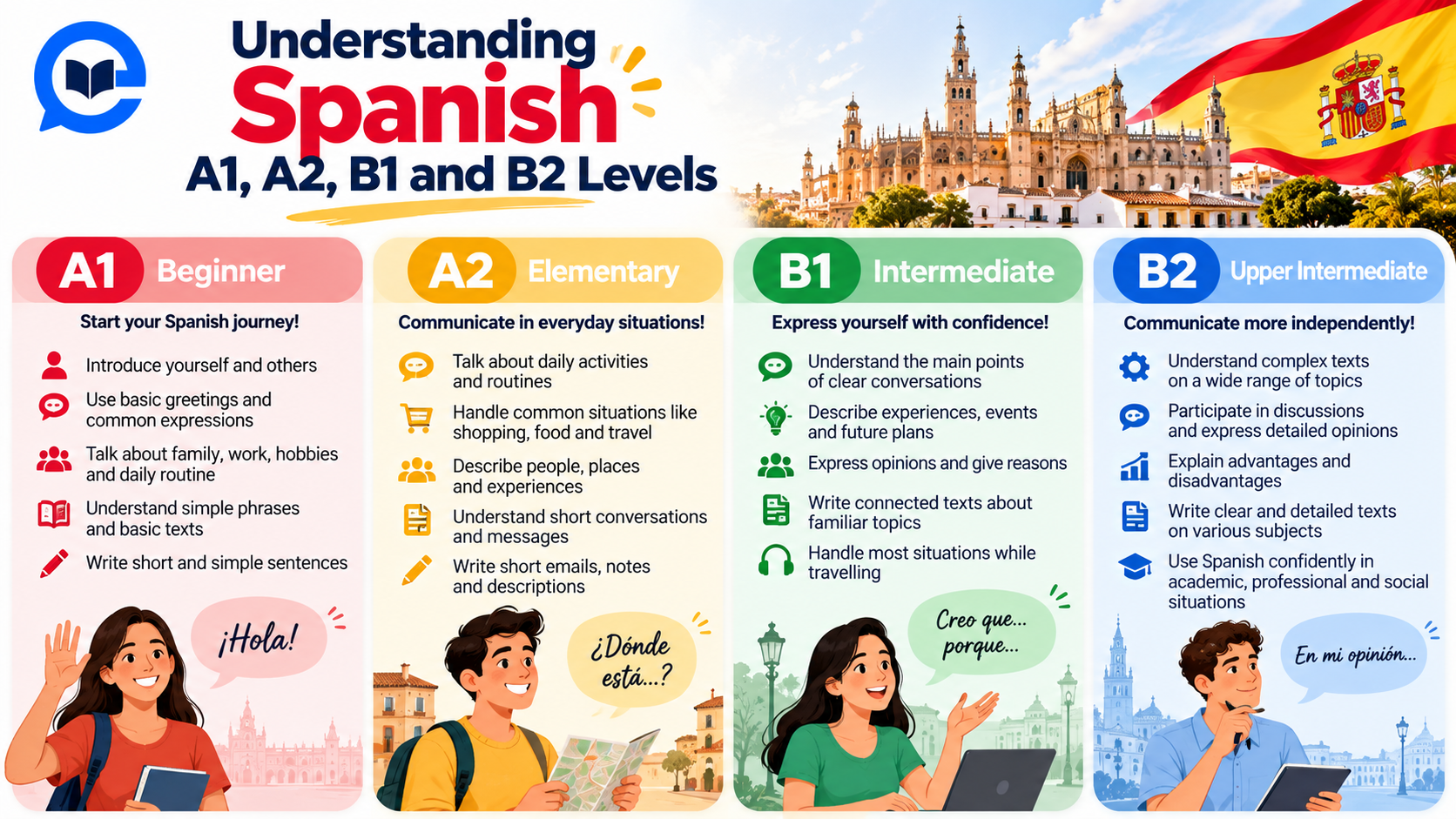
The Common European Framework of Reference for Languages (CEFR) describes language proficiency through six main levels, from A1 to C2.
A1 and A2 are basic-user levels, while B1 represents an intermediate stage of independent communication.
Spanish A1: Beginner Level
Spanish A1 is the starting point for learners with little or no previous knowledge of the language.
At A1, you will learn to:
- Introduce yourself and share basic personal information.
- Greet people and ask simple questions.
- Talk about family, work, hobbies and everyday activities.
- Understand familiar words and short, simple messages.
- Use basic Spanish grammar and common vocabulary.
- Write simple sentences and short personal messages.
Example in Spanish:
Hola, me llamo Ana. Soy de India. Estoy aprendiendo español.
English translation: Hello, my name is Ana. I am from India. I am learning Spanish.
Who should learn A1? Complete beginners who want to build a strong foundation in Spanish pronunciation, grammar, vocabulary and conversation.
Spanish A2: Elementary Level
Spanish A2 helps you communicate more confidently in familiar and routine situations.
At this level, you will practise how to:
- Describe your daily routine and personal experiences.
- Talk about shopping, food, travel and everyday needs.
- Describe people, places and familiar events.
- Understand straightforward conversations and messages.
- Write short emails, notes and descriptions.
- Use common past-tense forms and everyday expressions.
Example in Spanish:
Ayer fui al mercado y compré fruta para mi familia.
English translation: Yesterday, I went to the market and bought fruit for my family.
Who should learn A2? Learners who already understand basic Spanish and want to develop stronger everyday communication skills.
Spanish B1: Intermediate Level
Spanish B1 helps you communicate more independently across familiar personal, social, educational and travel situations.
At this level, you will work towards being able to:
- Understand the main points of clear conversations on familiar topics.
- Describe experiences, events and future plans.
- Express opinions and explain your reasons.
- Write connected texts about familiar subjects.
- Handle many common situations while travelling.
- Participate in conversations with greater independence.
Example in Spanish:
Me gustaría trabajar en un entorno internacional porque quiero conocer otras culturas y mejorar mis habilidades lingüísticas.
English translation: I would like to work in an international environment because I want to discover other cultures and improve my language skills.
Who should learn B1? Learners who have completed the basics and want to communicate more independently in Spanish.
What Is the DELE Spanish Examination?
DELE stands for Diplomas de Español como Lengua Extranjera. These official diplomas certify Spanish-language proficiency at different levels.
The general DELE examinations include A1, A2, B1, B2, C1 and C2. If your goal is to certify your progress from beginner to intermediate Spanish, you may want to explore the DELE A1, A2 and B1 examinations.
The general DELE examinations assess four skills:
- Reading comprehension: Understanding written Spanish.
- Listening comprehension: Understanding spoken Spanish.
- Written expression and interaction: Producing appropriate written responses.
- Oral expression and interaction: Speaking and interacting in Spanish.
The examination tasks and timings differ by level. You can find official information and sample examination materials through Instituto Cervantes.
Remember that a Spanish course and an official DELE examination are different. Completing a course does not automatically award a DELE diploma; you must register for and pass the relevant official examination.
DELE A1, A2 and B1 Exam Pattern
Understanding the examination format can help you plan your preparation more effectively.
| Exam component | DELE A1 | DELE A2 | DELE B1 |
|---|---|---|---|
| Reading | 45 minutes | 60 minutes | 70 minutes |
| Listening | 20 minutes | 35 minutes | 40 minutes |
| Writing | 25 minutes | 50 minutes | 60 minutes |
| Speaking | 30 minutes* | 30 minutes* | 30 minutes* |
<text color="secondary" size="sm">*These are published standard general-exam timings; oral-test arrangements may include preparation time and can vary according to the level's format. Confirm the current specifications in the official candidate guide before your examination. Source: Instituto Cervantes examination information.</text>
The four components test different skills, so your preparation should include regular reading, listening, writing and speaking practice rather than focusing on grammar alone. Official level-specific formats are available from Instituto Cervantes.
How to Learn Spanish Online from A1 to B1
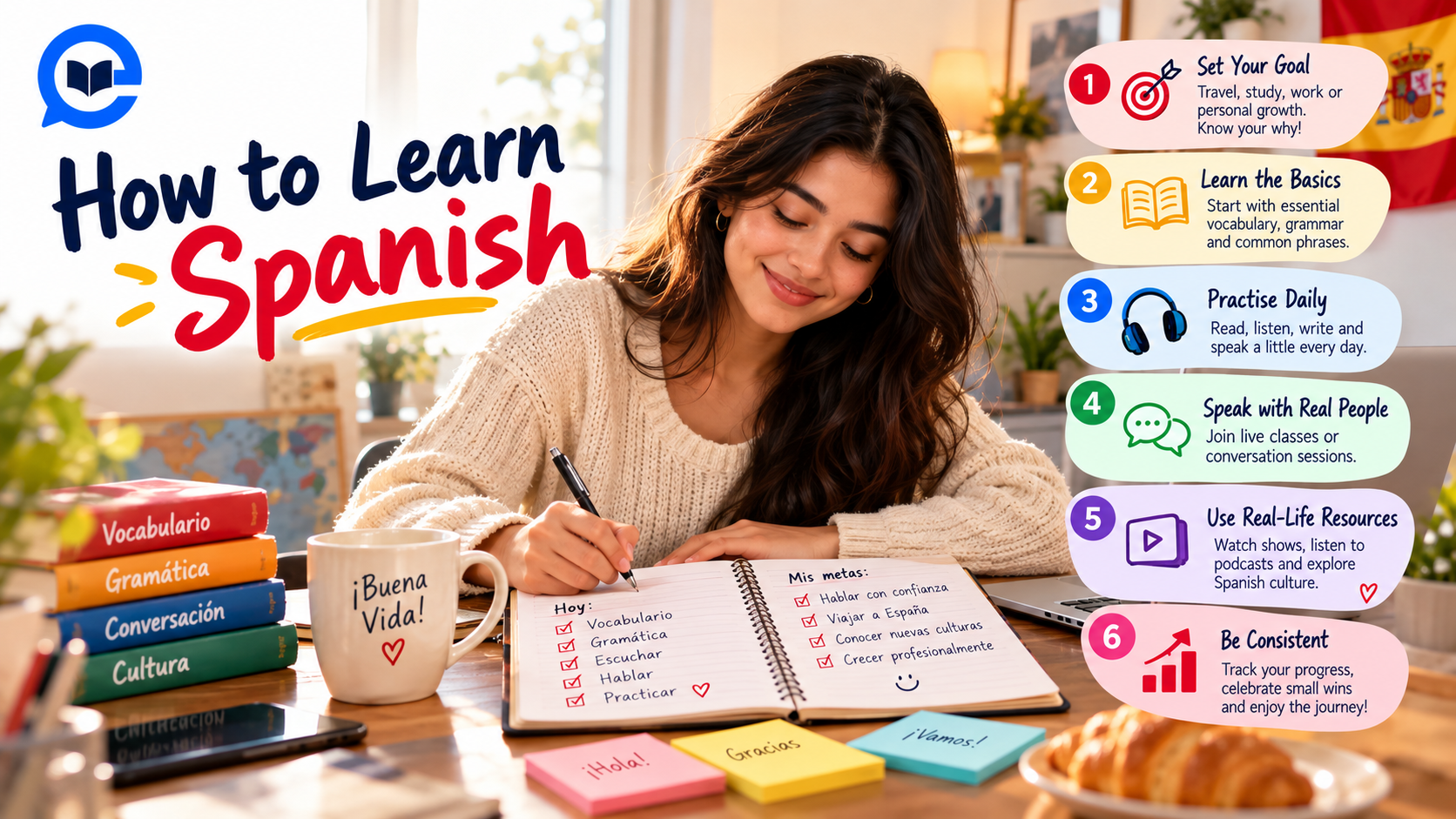
The best way to learn Spanish is to combine structured lessons with consistent practice and opportunities to use the language.
Step 1: Build Your A1 Foundation
Start with pronunciation, essential vocabulary, greetings, introductions, articles, gender, common verbs and simple sentence structures.
Practise talking about yourself, your family, your daily routine and your interests. Build a vocabulary notebook and revise it regularly.
Step 2: Strengthen Your A2 Communication Skills
Once you have a foundation, move towards longer conversations and more detailed sentences.
Practise describing past experiences, making plans, asking for information and handling everyday situations. Review grammar in context rather than memorising rules in isolation.
Step 3: Develop Independent Communication at B1
At B1, focus on connecting ideas and communicating your opinions clearly.
Practise describing experiences, explaining plans, comparing options and supporting your opinions with reasons. Read longer texts, listen to level-appropriate audio and write connected paragraphs.
Step 4: Practise All Four Language Skills
Give attention to reading, listening, writing and speaking throughout your learning journey.
Use Spanish audio recordings, short articles, writing exercises and conversations. Review your mistakes and practise the areas that need improvement.
Step 5: Prepare for DELE if Certification Is Your Goal
If you intend to take DELE A1, A2 or B1, use official sample examinations to become familiar with the format and task types.
Practise under timed conditions, seek feedback on your writing and speaking, and review the candidate requirements for your chosen level.
Your 12-Week Spanish Study Plan
This sample schedule can help you organise your learning. It assumes regular study and is intended as a framework, not a guarantee that every learner will reach B1 in 12 weeks.
| Weeks | Learning focus | Recommended activities |
|---|---|---|
| 1–4 | A1 foundations | Pronunciation, greetings, basic grammar, vocabulary and simple conversations |
| 5–8 | A2 development | Everyday conversations, common past-tense forms, reading and short writing tasks |
| 9–10 | B1 communication | Expressing opinions, describing experiences and writing connected texts |
| 11 | Skill development | Listening practice, speaking sessions and targeted grammar revision |
| 12 | Assessment and review | Mock tasks, feedback and a review of readiness for the next level |
Your actual timeline will depend on your starting point, available study hours, previous language experience and learning consistency.
Recommended Daily Spanish Routine
If you can dedicate 60 minutes a day, try this routine:
- 10 minutes: Vocabulary revision.
- 15 minutes: Grammar and sentence construction.
- 15 minutes: Listening or reading practice.
- 15 minutes: Speaking or writing practice.
- 5 minutes: Review mistakes and revise difficult expressions.
Consistency matters more than completing a large amount of material in a single session.
Common Mistakes to Avoid When Learning Spanish
Memorising vocabulary without using it: Write your own sentences and use new words in conversation.
Ignoring pronunciation: Listen to native or proficient speakers and practise repeating short phrases.
Studying grammar without speaking: Use each new grammar structure in real communication.
Translating every sentence from English: Learn common Spanish expressions and practise thinking directly in Spanish.
Avoiding listening practice: Regular exposure to spoken Spanish helps improve comprehension.
Skipping revision: Revisit older vocabulary and grammar so that your knowledge becomes more secure.
Preparing for an exam without knowing the format: If you plan to take DELE, practise with official sample materials and understand the tasks required at your level.
Why Choose Impearly for Your Spanish-Learning Journey?

Learning a language is easier to organise when you have a clear goal, a suitable course and a consistent study routine.
When choosing an online Spanish course, look for:
- A structured curriculum from beginner to intermediate level.
- Lessons covering grammar, vocabulary and communication.
- Opportunities to practise speaking and listening.
- Feedback on written and spoken work.
- A learning plan that matches your current proficiency.
- Examination-focused preparation if DELE certification is your goal.
- Transparent information about fees, schedules and course duration.
At Impearly – Your Global Language Partner, you can explore language-learning options and enquire about the Spanish course that fits your goals.
Whether you want to start with Spanish A1, progress through A2 or work towards B1, choose a learning pathway that suits your current level and available study time.
Ready to take the first step?
Visit www.impearly.com to explore your options and enquire about available Spanish classes.
Frequently Asked Questions About Spanish A1–B1 Courses
1. Can I learn Spanish online as a complete beginner?
Yes. Online learning can help beginners build their Spanish foundations through structured lessons, vocabulary practice, grammar exercises and conversation activities.
2. What is the difference between Spanish A1, A2 and B1?
A1 focuses on basic communication, A2 develops everyday communication skills, and B1 supports more independent communication about familiar topics and experiences.
3. Is DELE the same as a Spanish course?
No. A Spanish course helps you learn the language, while DELE is an official examination that assesses your proficiency. Completing a course does not automatically award the diploma.
4. Can I take the DELE A2 exam without taking DELE A1?
Generally, you do not need to hold a DELE A1 diploma before registering for the general DELE A2 examination. Choose the level that matches your proficiency and confirm current registration requirements with your examination centre.
5. How long does it take to learn Spanish from A1 to B1?
The time varies according to your starting level, study schedule, practice and exposure to Spanish. Set realistic milestones and assess your progress regularly rather than relying on a fixed timeline.
6. Is DELE B1 useful for work or study?
DELE B1 can provide evidence of Spanish proficiency. Whether it meets your needs depends on the requirements of the employer, university or organisation concerned.
7. Where can I find official DELE sample papers?
Visit the official Instituto Cervantes examination website for information about DELE levels, examination formats and sample materials.
8. How do I choose the right Spanish course?
Start by assessing your current ability and defining your goal. If you are a complete beginner, A1 is a suitable starting point. If you already know some Spanish, a level assessment can help you identify the appropriate course.
Start Learning Spanish with Impearly Today
Your Spanish-learning journey can begin with one simple step: choosing the right starting point.
Build your foundation with A1, strengthen your everyday communication with A2, and work towards greater independence at B1. If you need official certification, explore the relevant DELE examination and prepare with a clear study plan.
🌎 One language can open new doors. Your next opportunity could begin with Spanish.
At Impearly, explore your language-learning options and take the next step towards your goals.
Ready to begin?
Visit www.impearly.com to enquire about Spanish courses and find a learning pathway that suits you.
Impearly — Learn with purpose. Communicate with confidence. Expand your world.
Enjoyed this article? Visit impearly.com to explore our full range of language programmes.